


Rockets can be tricky, or they can be as simple as inflating a balloon! It all depends on your perception, knowledge, and experience.
Our rocket balloon project is a simple and fun experiment that can be done with just simple things that you can easily find at home. However, it will help kids understand the basics of rocketry and Newton's third law!
Required materials for balloon rocket:
- round-shaped balloon (or elongated one);
- adhesive tape;
- scissors;
- cocktail straw (the one without the flexible part);
- string (10-15 feet long);
- clothespin.
Also, you may need some assistance from a true friend who will help you conduct an experiment using all these balloon rocket materials!
How to make rocket balloon at home: manual
Stage 1: find two stationary objects that are 10-15 feet apart from each other and of the same height (or place heavy, stable objects opposite each other). Tie one end of your string tightly to one of the objects.
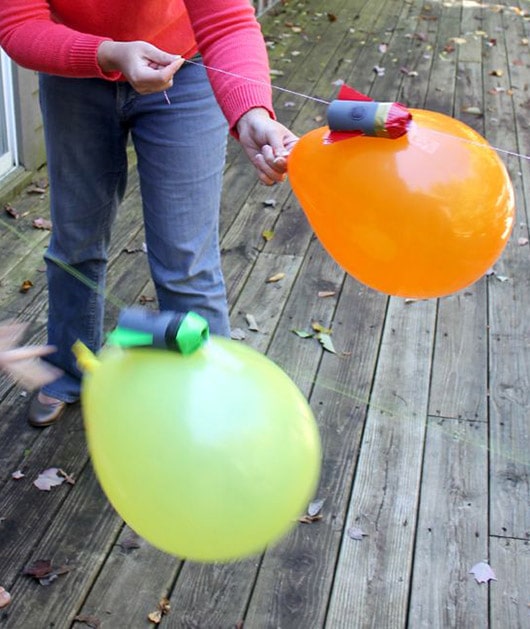 If you are conducting your balloon rocket experiment at home, you can use chairs, tables, stair railings, doorknobs — anything that is difficult to move. As an alternative option, you can try to make a balloon rocket in the street, where you can tie the string to tree trunks or posts. Moreover, here, on the street you can open up new horizons for the experiment: you can use a longer strip and larger balloon, taking it to the next level!
Stage 2: now, take the free end of your string and insert it into your drinking straw and pull it from the other end. If you fail and the rope is too thick, try to find a thinner one. The rope will become a “track” that will help the “rocket” to smoothly move along, and the straw will function as a movable connecting element.
Stage 3: cut two medium-sized tape strips (7-10 cm each). Now, take the straw and attach both tape strips to it closer to the middle, but keeping some distance from each other. This is very important, because if you stick the tape closer to the ends of the straw, it will bend as it moves, and your balloon won’t fly as fast as real rockets do!
Stage 4: firmly tie the other end of the string (the one we’ve threaded through the straw) to the second stationary object. Make sure that both ends of the rope are tightly fixed and the string is stretched as evenly as possible between them. If the string isn’t stretched enough, just move one object away from another as far as possible.
Stage 5: inflate your balloon and hold its neck with your finger, grab a clothespin, and secure the neck tightly to prevent the balloon from deflating. Now, attach one side of the balloon to tape strips attached to the straw. Now, your balloon is fixed on the “track”.
You may ask yourself — how do I make a balloon rocket look like a real rocket? Just cut out four fins, tape another straw to your balloon and then, tape fins to the bottom of the straw (but leave a little room so you can easily inflate the balloon).
Stage 6: Are you ready to start the experiment?! Now, you will have to be very attentive, because things will be happening very, very quickly!
Let's start a balloon rocket!
If you did everything right, when you remove the clothespin from the neck of the balloon, it will fly along the “track” at great speed, like a real rocket!
We bet you’re dying to know how it works… Then read on!
How it Works
Now you know how to make a rocket balloon, and let's see how it works!
The inflated balloon is completely filled up with air — that’s simple. However, as soon as you release the neck of the balloon, the air is ejected from the ball with tremendous speed and force, creating a powerful thrust and causing the ball to fly forward.
The power of airflow, moving in one direction causes the same power to move the object in the opposite way. This experiment is the easiest way to explain Newton's third law at home, which says: “Every action has an opposite reaction”.
The fact that the balloon flies when the air bursts out of it at a great speed makes it look like a real rocket!
The only difference is that it is not the air that bursts from the rocket nozzles, but the compressed gas that occurs when fuel is burned in a special open compartment of the rocket engine. The compressed gas erupts downward, making the rocket fly upward, overcoming gravity!
More balloon-powered rocket ideas
How to make a balloon rocket to get maximum fun and knowledge? Write down the following ideas for your next exciting experiments:
- Buy balloons of different sizes and shapes to determine how these parameters affect the speed of your “rocket”;
- try using a longer or shorter string and see what impact it will have;
- conduct a new experiment and find out what happens if you use a thick rather than a thin straw;
- do several different rocket balloon experiments using different types of string (twine, yarn, thread) and try to figure out whether this affects the speed of the “rocket” and its flight range;
- change the inclination angle of the string and try to find out how this affects the speed of the balloon and its flight range;
- use two identical balloons, placing them face-to-face and back-to-back and see what happens in this case;
- having mastered the balloon rocket on string mechanics, you can organize real “rocket balloon races” with your friends by pulling two or more strings parallel to each other and launching several different balloons!
Balloon rocket project: science fun for kids
Making a balloon rocket at home may not be quite as exciting as a real-life rocket launch, but it sure provides a memorable and enjoyable learning experience for kids!
Become a rocket scientist and explore the basic concepts of physics today! Remember: it is as simple as inflating a balloon! Good luck! Balloons Online provides the best balloons for any occasion at prices that make sense. Check us out at balloons.online!


